
Discussion - Member to Member Sales - Research Center
Discussion - Member to Member Sales - Research Center


12:48:49pm

EDIT: If anyone gets a chance to visit downtown Halifax (parking is a major problem) you have to visit this museum! Where else will you see deck chairs from the Titanic? Also if you're into scale models some of the ones they have are incredible. I know people who have lived in the city for many years and have never visited the local museums, it's amazingly stupid!!

8 Members
like this post.
Login to Like.
I don't have anything quite as unique as that. If I did, I would be proud to own it.
The closest I can come is a tag that was attached to a bag of cash.

7 Members
like this post.
Login to Like.
04:10:36pm
Great item Antonio! It's stuff like these odd items that make collections more interesting. "What they're worth" really doesn't matter, it makes the album more fun to look at! I put quite a bit of this stuff on the back of album pages so I actually see them more often. I also have about a douzen stock books full of stuff but I really don't look at them as often as I should. The only problem is the darn album bulge!!!
4 Members
like this post.
Login to Like.


09:46:30pm
I don't know if this is an urban myth or not but I read somewhere about someone trying to send a person through the mail because it was cheaper than a train. Is it true... GOK!!!
Login to Like
this post
There are a few known examples of babies and children being sent through the mail.
https://www.history.com/news/mailing-chi ...
Login to Like
this post


03:13:27pm
Great item Vince, thanks for posting. I think items like this really jazz up a collection!!
Login to Like
this post
12:56:58pm
I collect items from my home county, Queen's, in Nova Scotia. A friend gave me this cover, Ruth Fiander (lived to be 105 years old) was her mother and a member of this society, Joseph was her older son. The stamp is totally unimportant but I really treasure the cover!! Excellent handwriting as well, a lost art!

Another interesting piece I picked up a few years ago because of the Nova Scotia connection. It's in pretty poor shape and a poor picture as well. The note at the bottom (Maritime Mail ) reads as follows.
"17 January 1853. An entire from Pictou, Nova Scotia to Scotland; fine "Pictou N.S. Paid in red. Paid double split ring, and m/s "1/- Stg "1/3 Cy", also "10' credit to UK. On reverse Pictou cds and Halifax oval transit. Carried by Canard Line "America", with Liverpool tombstone transit and boxed blue "SANQUHAR" arrival. Filing crease and repaired tear, otherwise fine and unusual!"
I really like the tombstone postmark from Liverpool, England and the name of the Scottish town, Sanquhar. Fun piece of packet mail!!
Originally I bought it because I thought it was my home town of Liverpool, Nova Scotia but I still really like the item.

A better picture of the ship America

4 Members
like this post.
Login to Like.
03:44:30pm
Can anyone tell me what 1/- Stg "1/3 Cy actually means, I'm not that familiar with that type of thing?
Login to Like
this post

03:56:17pm
One shilling sterling / one shilling 3 pence currency
The "currency" denomination quoted on Canadian stamps referred to the colonial Canadian pound, which was tied to the Spanish dollar (or "pieces of eight") and its descendants, commonly used in North America during the 18th and early 19th centuries. Canadian currency evolved from a mixture of currencies circulating in the region, primarily British and Spanish systems.
By the early 19th century, the Canadian colonies adopted a system based on the Halifax standard, where the Canadian pound was valued at 4 Canadian dollars to 1 British pound sterling. Thus, the exchange rate between sterling and Canadian currency was fixed at 1 pound sterling = 1 pound 4 shillings (1.25 Canadian pounds or 25 Canadian shillings). This exchange rate accounts for the discrepancy seen in the dual denominations on stamps and other financial instruments of the time.
Roy
6 Members
like this post.
Login to Like.
04:10:11pm
Thanks Roy, I learned something today - that's always a good thing! I had no idea how Canada's currency was based at this time!
Login to Like
this post
05:46:54pm
There's another aspect to the letter - tombstone cancellations! I believe there is someone out there who collects Canadian versions of this cancel. I think Halifax, Nova Scotia was responsible for some of them.
1 Member
likes this post.
Login to Like.
07:30:57pm
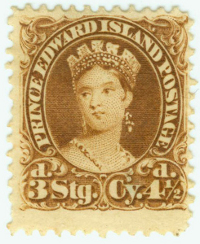
Some samples of early Canada / provinces with dual currency quotes in local currency (what the catalogues list as the denomination) and equivalent sterling.


Roy
7 Members
like this post.
Login to Like.
08:52:37pm
Thanks Roy. I have 2 out of those three stamps and never even took note of, or understood, what the denomination meant. Great copies of those stamps, I envy your #9 and hope to have one eventually. Thanks again, again a day where I learned some real good stuff!!!
1 Member
likes this post.
Login to Like.
Vinman said, "Harvey, I have a cloth bag used for sending film to be developed, I'll post later."
When I was in South Vietnam during the Vietnam War, I used Kodachome slide film, which came with a mailer so you could send it to Kodak for processing.* I used my parents' address so the photographs would be sent home to wait for my return. Mom and Dad were probably quite disturbed to see some of my photos!
Bob
* Kodachrome could only be processed by specialized equipment at a handful of Kodak labs around the country, or more probably the world. It was only a few years ago that the last roll of Kodachrome was processed.
Login to Like
this post
I like offbeat philatelic items too, like this shipping tag:

The shipping tag works on several levels for me:
• The high-value stamps from Canada's "War Issue" are among my favourite stamps of all time, and dovetail perfectly with my interest in Canada's use of the 25-Pounder artillery piece in Europe following D-Day, and in the Canadian corvettes that were instrumental in the Battle of the Atlantic.
• The tag represents a time when the world was a different, more trusting and more trustworthy place where you could put a lot of cash in a bag and mail it, even marking the tag as containing case for a payroll, in this case the Chinese payroll at the pulp and paper mill at Woodfibre, BC, on the north shore of Howe Sound, north of Vancouver.
• The tag is clear evidence of a sea-change in forestry practices in British Columbia. Before the incarceration of Canada's Japanese citizens, large numbers of Japanese worked in BC's forests, lumber mills, and pulp mills. All of them summarily lost their jobs, and in many cases their homes and businesses. Canada, unlike the United States, had already been at war since September, 1939, and many Caucasian forestry workers had joined the military. The only source of workers in forestry was the large Chinese-Canadian population.
Chinese had started coming to BC in the mid-to-late 1800s with the promise of riches to come from building the Canadian Pacific Railway,which gave them hope that they bring their wives and families from China. However, in a situation that was duplicated in America, they but were met with poor pay and terrible, even deadly working conditions. When the attack on Pearl Harbor happened, large numbers of single, unemployed Chinese men lingered in the slums of Vancouver's Chinatown — until the forestry industry realized that the Chinese men represent a large number of potential employees. Soon, Chinese men were working the same jobs that the Japanese had held.
The company owned town at Woodfibre was shut down in the 1960, but the mill continued to operate; a ferry service was provided for workers until 2006, when the mill itself was shut down. The site is currently being developed as a liquid natural gas depot.
The shipping tag sent me on a long search for more information about Woodfibre and its history. Eventually, I published a web page about it, PAYDAY AT WOODFIBRE — A bag of cash for Chinese workers at a BC pulp and paper mill. It includes information not only about the Chinese at Woodfibre and in BCs Forests generally, but also about the dismal situation under which the Japanese internees lived.
Bob
6 Members
like this post.
Login to Like.
09:40:58pm
I have this very small collection and think these are "very neat items" as well!

This is what a complete sheet looks like! Not mine, but I wish it was!!

EDIT: I believe this is sort of two panes from a master sheet of 4. I've considered collecting these since I'm a semi - serious (don't really try for the really early stuff and sort of start at around #50 ) collector of NZ. It's just that I have so many different areas on the go now that one more is hard to imagine! That one small collection makes for a nice example and I picked it up in that form from my local dealer.
5 Members
like this post.
Login to Like.
I have always wanted to mail myself a cocounut. This is possible according to USPS rules (last I checked). The problem is it wouldn't fit in any of my albums.
3 Members
like this post.
Login to Like.
06:41:33pm
Smauggie - You'll like this!!!!
https://www.youtube.com/watch?v=5jHBTJyB ...
Login to Like
this post
06:23:39pm
I think a 1890 money order is pretty cool. I picked it up from a seller here!


4 Members
like this post.
Login to Like.
Harvey:
Your document is not the actual Money Order, but one of the auxiliary documents that are part of the transaction. It is called the Money Order Advice, and its purpose is described below.
I am not as familiar with the Canadian Money Order system as I am the one used in the United States, but I believe they functioned in a similar manner. If I have missed a difference in the Canadian system, perhaps Roy can correct me.
For security purposes, when a postmaster sold a money order to a customer, the customer was required to first complete an application that identified the (a) name of the person who was to be paid by the money order, (b) the amount to be paid, and (c) the location of the post office where the money order was to be paid to the recipient.
The postmaster then added this information to two additional forms: (a) the actual Money Order, and (b) the Money Order Advice. He would also make an entry in his Money Order Ledger noting the money order number, the date, the purchaser, the payee, the amount to be paid.
The customer was given the actual money order, and he would typically send (mail) it to the designated payee. The postmaster would then send the Money Order Advice to the postmaster where the money order was to be paid. This notified the postmaster at that office that he would be required to pay a money order in the designated amount in the near future.
This protected the postal system from the theft of blank money order forms, as the stolen money order could not be presented for payment because there would be no corresponding advice at the paying post office. In the uncomment event that the designated post office had not previously received an advice for a legitimate money order, that postmaster would have to request a duplicate advice from the originating post office, which would delay the payment transaction for several days.
Once the money order was paid, the paying postmaster would notify the postmaster at the issuing post office that the money order had been paid.
Postmasters maintained the cash in their Money Order funds account separately from their post office account. They had limitations on how much cash they were able to retain in their money order account, and when they had an excess, they would send it to their administrative post office. When a postmaster received an advice, or a series of these advices in a short period of time, which had a total value that exceeded the current balance in his money order account, he could request additional funds from the administrative office to cover the expected disbursements. This also had the advantage of limiting the amount of money that a postmaster had to keep in the post office in the event of a robbery or burglary, for which he was personally responsible.
This procedure also helped the postal system move funds from where they were received to where they would be needed to make redemptions of money orders.
I have probably omitted a few details, but this outlines the general procedure.
MikeL
3 Members
like this post.
Login to Like.
08:47:21am
Thanks Mike, great explanation! I think I got this from Dennis, if I'm wrong I'm sorry. Things like this are nor real expensive but IMHO they add interest to a collection!
Login to Like
this post
Back when I had a bunch! I think, therefore I am - I think! Descartes, sort of!
18 Mar 2024
12:48:49pm
Have had this for quite a while. I believe the proper name for this is a mailing bag and it's dimensions are 3 3/4" by 7 3/8" and is cloth. I picked it up at an antique auction many years ago as part of a huge lot of early locks and keys - it contained a padlock from the company. The company doesn't exist any more but it was a well known ship's chandlery in Halifax. It's store front is still on Lower Water Street and is part of the Maritime Museum of the Atlantic. It only has historic value for me so I don't care if there is monetary value, it's just a real neat item IMHO!! It has a place of honour in my collection on the page next to that series of 1942 - 43 stamps contributing to my case of album bulge. Does anyone of you collect this sort of "stuff"?
EDIT: If anyone gets a chance to visit downtown Halifax (parking is a major problem) you have to visit this museum! Where else will you see deck chairs from the Titanic? Also if you're into scale models some of the ones they have are incredible. I know people who have lived in the city for many years and have never visited the local museums, it's amazingly stupid!!
8 Members
like this post.
Login to Like.

re: Very neat items, or at least I think so!!
I don't have anything quite as unique as that. If I did, I would be proud to own it.
The closest I can come is a tag that was attached to a bag of cash.
7 Members
like this post.
Login to Like.
Back when I had a bunch! I think, therefore I am - I think! Descartes, sort of!
18 Mar 2024
04:10:36pm
re: Very neat items, or at least I think so!!
Great item Antonio! It's stuff like these odd items that make collections more interesting. "What they're worth" really doesn't matter, it makes the album more fun to look at! I put quite a bit of this stuff on the back of album pages so I actually see them more often. I also have about a douzen stock books full of stuff but I really don't look at them as often as I should. The only problem is the darn album bulge!!!
4 Members
like this post.
Login to Like.
Back when I had a bunch! I think, therefore I am - I think! Descartes, sort of!
18 Mar 2024
09:46:30pm
re: Very neat items, or at least I think so!!
I don't know if this is an urban myth or not but I read somewhere about someone trying to send a person through the mail because it was cheaper than a train. Is it true... GOK!!!
Login to Like
this post
re: Very neat items, or at least I think so!!
There are a few known examples of babies and children being sent through the mail.
https://www.history.com/news/mailing-chi ...
Login to Like
this post
Back when I had a bunch! I think, therefore I am - I think! Descartes, sort of!
22 Mar 2024
03:13:27pm
re: Very neat items, or at least I think so!!
Great item Vince, thanks for posting. I think items like this really jazz up a collection!!
Login to Like
this post
Back when I had a bunch! I think, therefore I am - I think! Descartes, sort of!
01 Jan 2025
12:56:58pm
re: Very neat items, or at least I think so!!
I collect items from my home county, Queen's, in Nova Scotia. A friend gave me this cover, Ruth Fiander (lived to be 105 years old) was her mother and a member of this society, Joseph was her older son. The stamp is totally unimportant but I really treasure the cover!! Excellent handwriting as well, a lost art!
Another interesting piece I picked up a few years ago because of the Nova Scotia connection. It's in pretty poor shape and a poor picture as well. The note at the bottom (Maritime Mail ) reads as follows.
"17 January 1853. An entire from Pictou, Nova Scotia to Scotland; fine "Pictou N.S. Paid in red. Paid double split ring, and m/s "1/- Stg "1/3 Cy", also "10' credit to UK. On reverse Pictou cds and Halifax oval transit. Carried by Canard Line "America", with Liverpool tombstone transit and boxed blue "SANQUHAR" arrival. Filing crease and repaired tear, otherwise fine and unusual!"
I really like the tombstone postmark from Liverpool, England and the name of the Scottish town, Sanquhar. Fun piece of packet mail!!
Originally I bought it because I thought it was my home town of Liverpool, Nova Scotia but I still really like the item.
A better picture of the ship America
4 Members
like this post.
Login to Like.
Back when I had a bunch! I think, therefore I am - I think! Descartes, sort of!
01 Jan 2025
03:44:30pm
re: Very neat items, or at least I think so!!
Can anyone tell me what 1/- Stg "1/3 Cy actually means, I'm not that familiar with that type of thing?
Login to Like
this post
BuckaCover.com - 80,000 covers priced 60c to $1.50 - Easy browsing 500 categories
01 Jan 2025
03:56:17pm
re: Very neat items, or at least I think so!!
One shilling sterling / one shilling 3 pence currency
The "currency" denomination quoted on Canadian stamps referred to the colonial Canadian pound, which was tied to the Spanish dollar (or "pieces of eight") and its descendants, commonly used in North America during the 18th and early 19th centuries. Canadian currency evolved from a mixture of currencies circulating in the region, primarily British and Spanish systems.
By the early 19th century, the Canadian colonies adopted a system based on the Halifax standard, where the Canadian pound was valued at 4 Canadian dollars to 1 British pound sterling. Thus, the exchange rate between sterling and Canadian currency was fixed at 1 pound sterling = 1 pound 4 shillings (1.25 Canadian pounds or 25 Canadian shillings). This exchange rate accounts for the discrepancy seen in the dual denominations on stamps and other financial instruments of the time.
Roy
6 Members
like this post.
Login to Like.
Back when I had a bunch! I think, therefore I am - I think! Descartes, sort of!
01 Jan 2025
04:10:11pm
re: Very neat items, or at least I think so!!
Thanks Roy, I learned something today - that's always a good thing! I had no idea how Canada's currency was based at this time!
Login to Like
this post
Back when I had a bunch! I think, therefore I am - I think! Descartes, sort of!
01 Jan 2025
05:46:54pm
re: Very neat items, or at least I think so!!
There's another aspect to the letter - tombstone cancellations! I believe there is someone out there who collects Canadian versions of this cancel. I think Halifax, Nova Scotia was responsible for some of them.
1 Member
likes this post.
Login to Like.
BuckaCover.com - 80,000 covers priced 60c to $1.50 - Easy browsing 500 categories
01 Jan 2025
07:30:57pm
re: Very neat items, or at least I think so!!
Some samples of early Canada / provinces with dual currency quotes in local currency (what the catalogues list as the denomination) and equivalent sterling.
Roy
7 Members
like this post.
Login to Like.
Back when I had a bunch! I think, therefore I am - I think! Descartes, sort of!
01 Jan 2025
08:52:37pm
re: Very neat items, or at least I think so!!
Thanks Roy. I have 2 out of those three stamps and never even took note of, or understood, what the denomination meant. Great copies of those stamps, I envy your #9 and hope to have one eventually. Thanks again, again a day where I learned some real good stuff!!!
1 Member
likes this post.
Login to Like.

re: Very neat items, or at least I think so!!
Vinman said, "Harvey, I have a cloth bag used for sending film to be developed, I'll post later."
When I was in South Vietnam during the Vietnam War, I used Kodachome slide film, which came with a mailer so you could send it to Kodak for processing.* I used my parents' address so the photographs would be sent home to wait for my return. Mom and Dad were probably quite disturbed to see some of my photos!
Bob
* Kodachrome could only be processed by specialized equipment at a handful of Kodak labs around the country, or more probably the world. It was only a few years ago that the last roll of Kodachrome was processed.
Login to Like
this post
re: Very neat items, or at least I think so!!
I like offbeat philatelic items too, like this shipping tag:
The shipping tag works on several levels for me:
• The high-value stamps from Canada's "War Issue" are among my favourite stamps of all time, and dovetail perfectly with my interest in Canada's use of the 25-Pounder artillery piece in Europe following D-Day, and in the Canadian corvettes that were instrumental in the Battle of the Atlantic.
• The tag represents a time when the world was a different, more trusting and more trustworthy place where you could put a lot of cash in a bag and mail it, even marking the tag as containing case for a payroll, in this case the Chinese payroll at the pulp and paper mill at Woodfibre, BC, on the north shore of Howe Sound, north of Vancouver.
• The tag is clear evidence of a sea-change in forestry practices in British Columbia. Before the incarceration of Canada's Japanese citizens, large numbers of Japanese worked in BC's forests, lumber mills, and pulp mills. All of them summarily lost their jobs, and in many cases their homes and businesses. Canada, unlike the United States, had already been at war since September, 1939, and many Caucasian forestry workers had joined the military. The only source of workers in forestry was the large Chinese-Canadian population.
Chinese had started coming to BC in the mid-to-late 1800s with the promise of riches to come from building the Canadian Pacific Railway,which gave them hope that they bring their wives and families from China. However, in a situation that was duplicated in America, they but were met with poor pay and terrible, even deadly working conditions. When the attack on Pearl Harbor happened, large numbers of single, unemployed Chinese men lingered in the slums of Vancouver's Chinatown — until the forestry industry realized that the Chinese men represent a large number of potential employees. Soon, Chinese men were working the same jobs that the Japanese had held.
The company owned town at Woodfibre was shut down in the 1960, but the mill continued to operate; a ferry service was provided for workers until 2006, when the mill itself was shut down. The site is currently being developed as a liquid natural gas depot.
The shipping tag sent me on a long search for more information about Woodfibre and its history. Eventually, I published a web page about it, PAYDAY AT WOODFIBRE — A bag of cash for Chinese workers at a BC pulp and paper mill. It includes information not only about the Chinese at Woodfibre and in BCs Forests generally, but also about the dismal situation under which the Japanese internees lived.
Bob
6 Members
like this post.
Login to Like.
Back when I had a bunch! I think, therefore I am - I think! Descartes, sort of!
06 Jan 2025
09:40:58pm
re: Very neat items, or at least I think so!!
I have this very small collection and think these are "very neat items" as well!
This is what a complete sheet looks like! Not mine, but I wish it was!!
EDIT: I believe this is sort of two panes from a master sheet of 4. I've considered collecting these since I'm a semi - serious (don't really try for the really early stuff and sort of start at around #50 ) collector of NZ. It's just that I have so many different areas on the go now that one more is hard to imagine! That one small collection makes for a nice example and I picked it up in that form from my local dealer.
5 Members
like this post.
Login to Like.
re: Very neat items, or at least I think so!!
I have always wanted to mail myself a cocounut. This is possible according to USPS rules (last I checked). The problem is it wouldn't fit in any of my albums.
3 Members
like this post.
Login to Like.
Back when I had a bunch! I think, therefore I am - I think! Descartes, sort of!
08 Jan 2025
06:41:33pm
re: Very neat items, or at least I think so!!
Smauggie - You'll like this!!!!
https://www.youtube.com/watch?v=5jHBTJyB ...
Login to Like
this post
Back when I had a bunch! I think, therefore I am - I think! Descartes, sort of!
17 Aug 2025
06:23:39pm
re: Very neat items, or at least I think so!!
I think a 1890 money order is pretty cool. I picked it up from a seller here!
4 Members
like this post.
Login to Like.

re: Very neat items, or at least I think so!!
Harvey:
Your document is not the actual Money Order, but one of the auxiliary documents that are part of the transaction. It is called the Money Order Advice, and its purpose is described below.
I am not as familiar with the Canadian Money Order system as I am the one used in the United States, but I believe they functioned in a similar manner. If I have missed a difference in the Canadian system, perhaps Roy can correct me.
For security purposes, when a postmaster sold a money order to a customer, the customer was required to first complete an application that identified the (a) name of the person who was to be paid by the money order, (b) the amount to be paid, and (c) the location of the post office where the money order was to be paid to the recipient.
The postmaster then added this information to two additional forms: (a) the actual Money Order, and (b) the Money Order Advice. He would also make an entry in his Money Order Ledger noting the money order number, the date, the purchaser, the payee, the amount to be paid.
The customer was given the actual money order, and he would typically send (mail) it to the designated payee. The postmaster would then send the Money Order Advice to the postmaster where the money order was to be paid. This notified the postmaster at that office that he would be required to pay a money order in the designated amount in the near future.
This protected the postal system from the theft of blank money order forms, as the stolen money order could not be presented for payment because there would be no corresponding advice at the paying post office. In the uncomment event that the designated post office had not previously received an advice for a legitimate money order, that postmaster would have to request a duplicate advice from the originating post office, which would delay the payment transaction for several days.
Once the money order was paid, the paying postmaster would notify the postmaster at the issuing post office that the money order had been paid.
Postmasters maintained the cash in their Money Order funds account separately from their post office account. They had limitations on how much cash they were able to retain in their money order account, and when they had an excess, they would send it to their administrative post office. When a postmaster received an advice, or a series of these advices in a short period of time, which had a total value that exceeded the current balance in his money order account, he could request additional funds from the administrative office to cover the expected disbursements. This also had the advantage of limiting the amount of money that a postmaster had to keep in the post office in the event of a robbery or burglary, for which he was personally responsible.
This procedure also helped the postal system move funds from where they were received to where they would be needed to make redemptions of money orders.
I have probably omitted a few details, but this outlines the general procedure.
MikeL
3 Members
like this post.
Login to Like.
Back when I had a bunch! I think, therefore I am - I think! Descartes, sort of!
18 Aug 2025
08:47:21am
re: Very neat items, or at least I think so!!
Thanks Mike, great explanation! I think I got this from Dennis, if I'm wrong I'm sorry. Things like this are nor real expensive but IMHO they add interest to a collection!
Login to Like
this post